
The 2026 GeoTech Inflection: What Leaders Can't Ignore
IN THIS ISSUE:
What 2025 Revealed
The Year Everything Physical Became Strategic
2025 was supposed to be about AI models getting smarter. It turned out to be about who controls the physical infrastructure that makes AI possible — chips, energy, minerals — and what they're willing to trade for access.
The chip war became a toll road: NVIDIA can sell H200s to China if the U.S. takes 25%. The DRC-Rwanda peace deal made minerals diplomatic currency. And the "electron gap" emerged: China's power production since 2010 exceeded the rest of the world combined, and that grid is now a strategic asset. Meanwhile, Big Tech poured $340B+ into data centers, adding 35 GW of new global capacity.
The strategic implication for 2026: stop measuring AI competition by who builds the smartest model. The moat is now physical — chips, electrons, land, supply chains, diplomatic access to resources. Countries and companies that figured this out in 2025 will set the terms for everyone else.
ON THE RADAR
Three domains shaping the GeoTech landscape in 2026.
[COMPUTE]TECHNOLOGY INFRASTRUCTURE
Chip Diplomacy Replaces Chip Blockades
The H200 deal is the template. Expect more "approved customer" arrangements with revenue-sharing for the U.S. government. Export controls become negotiable based on strategic value or strategic gifts, not binary restrictions. Use foresight and early signal radars to understand who is close to a deal and could enhance the resilience of your product value chains or market postures. Consider strategically placed investments to secure access.
Why this matters: Export controls are evolving from blanket bans to revenue-sharing arrangements. Companies that understand the new chip diplomacy playbook—where access is traded for equity stakes or strategic concessions—will secure supply while competitors face restrictions.
Canada’s F-35 Review Signals Deepening Alliance Uncertainty
Hours after being sworn in as Prime Minister in March 2025, Mark Carney ordered a review of Canada’s $19 billion contract with Lockheed Martin to purchase 88 F-35 fighter jets, citing tariffs and expansionist rhetoric from U.S. President Donald Trump. Foreign Minister Mélanie Joly pressed Lockheed Martin for additional industrial benefits or risk seeing the order scaled down, stating Ottawa could “procure fewer F-35s and complement them with Gripen Es assembled in Canada”. Carney emphasized the need to consider “value for money” and “the possibility of having substantial production of alternative aircraft in Canada—as opposed to sending, as we have been, on average, 80 cents of every dollar to the United States”. Canada is legally committed to purchasing only the first 16 F-35s, with infrastructure construction already underway at Cold Lake and Bagotville bases.
The industrial stakes are asymmetric. An F-35-heavy outcome keeps Canada embedded in the U.S.-centered (but multinational) F-35 supply base with established integration and maintenance ecosystems. A Gripen-heavy outcome enables more visible Canadian onshore work and gives Sweden scale, but reveals a critical constraint: the Gripen relies on U.S.-origin propulsion systems and related subsystems subject to American export controls. Canada’s pursuit of sovereignty through Swedish partnership still requires U.S. permission at the most critical technological layer. The question becomes whether Canada and Sweden can engineer around this dependency in the near term—or whether upstream IP ownership in high-end propulsion technology makes genuine sovereignty unattainable without prohibitive cost and timeline.
Why this matters:Unpredictable U.S. behavior toward allies erodes the trust required for defense supply chain scalability—and the damage extends beyond military procurement. When a founding NORAD member openly hedges against U.S. reliability by pursuing alternative suppliers, it signals that allies can no longer assume stable access to critical systems. This fragmentation will ripple through dual-use technologies where defense and civilian supply chains intersect: semiconductors, aerospace manufacturing, satellite systems, and AI infrastructure. The industrial analysis reveals a harder truth: even sovereignty-oriented procurement strategies hit the same chokepoint—U.S. control over upstream propulsion IP and export authority. Mid-tier allies seeking autonomy discover that diversification without technological independence merely relocates, rather than eliminates, dependence.
Central Asia Emerges as Alternative Infrastructure Hub
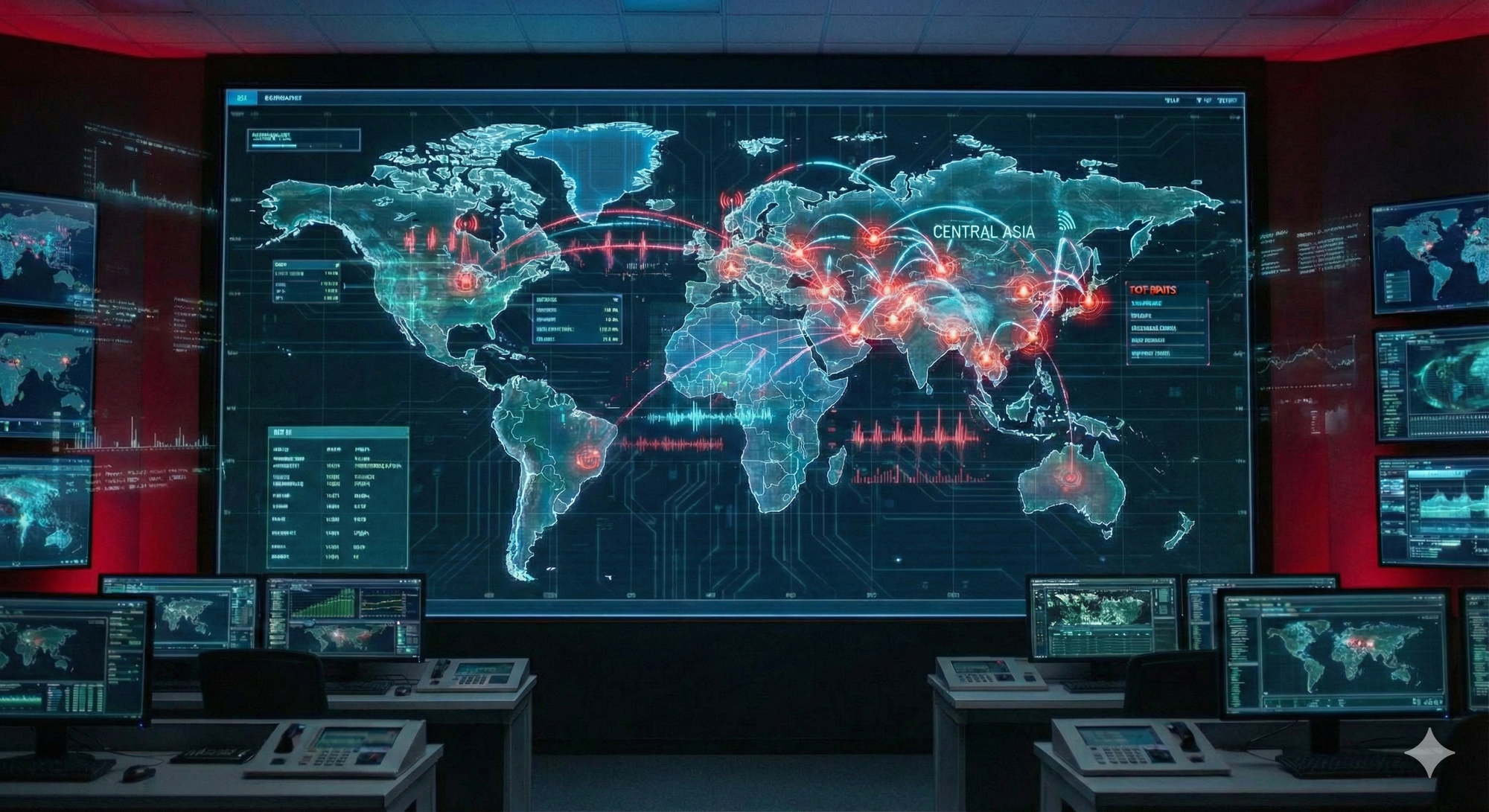
The C5+1 Summit in November signaled a new front in compute geopolitics. Kazakhstan announced a $2 billion AI Compute Hub with NVIDIA, plus $1B+ in deals with HPE, Cisco, and Oracle. The country produces 40% of the world's uranium, holds lithium and rare earth reserves, and offers energy-reliable capacity for hyperscale data centers outside traditional corridors. Consider alternative manufacturing, investment, and infrastructure hubs in your global value networks.
Why this matters: For companies caught between U.S. export controls and China dependence, Central Asia is emerging as neutral ground with energy, minerals, and strategic geography. First movers will lock in the best terms before the corridor becomes crowded.
U.S. Defense Competitiveness Under Scrutiny
The Pentagon's classified "Overmatch" brief, which recently surfaced in the NYT, catalogs China's ability to destroy U.S. fighter planes, large ships, and satellites. Defense Secretary Pete Hegseth acknowledged the U.S. "loses every time" in China war games. The assessment reveals overreliance on expensive, vulnerable weapons systems. Watch for leaner, more agile procurement opportunities away from large defense contractors.
Why this matters: The Pentagon is acknowledging openly what was whispered privately—legacy defense systems are vulnerable and too expensive to replace at scale. This creates openings for smaller, more agile defense tech companies that can deliver cheaper, distributed capabilities.
On Your Radar: Export controls are evolving from blanket bans to negotiated access arrangements—the H200 deal sets the template. Companies that understand this new playbook, where compute access is traded for equity stakes or strategic concessions, will secure supply. Meanwhile, compute geography is shifting to follow energy reliability, not talent pools. Kazakhstan's $2B AI hub signals that neutral, energy-rich territories outside traditional U.S./China corridors will capture infrastructure investment seeking geopolitical optionality.

[DATA]DATA & STACK SOVEREIGNTY
BeiDou Becomes a Full Strategic Stack
China's BeiDou Navigation Satellite System (BDS) now exceeds 2 billion supported devices, exports to 140+ countries, and is integrated into 11 international standards bodies. BDS has moved beyond GPS replacement to sovereign geospatial OS—integrating positioning, timing, secure military-grade navigation, and industrial automation. Autonomous ports using BDS report 25% efficiency gains. Watch for BeiDou exports embedded in Belt & Road infrastructure creating geospatial lock-in.
Why this matters: Every device, vehicle, or infrastructure system using BeiDou creates switching costs and data dependencies that compound over time. Belt & Road partners integrating BeiDou into critical infrastructure are building geospatial lock-in that's invisible until it's too late to unwind.
AI-Driven Earth Sensing Goes Autonomous
China is moving fast from passive satellite imaging to AI-native earth-observation agents that task satellites, fuse sensor layers, and trigger decisions automatically. The May 2025 launch of 12 satellites marked the first deployment of a planned 2,800-satellite "Star Computing" constellation. Key players — including CASC, CETC, and Huawei's cloud-AI geospatial stacks — are building real-time planetary command-and-control. This goes well beyond maps.
Why this matters: This isn't about better maps—it's about real-time situational awareness at planetary scale. Whoever controls the decision layer for sensing, targeting, and resource allocation owns strategic advantage in both military and climate domains.
India's Digital Public Infrastructure Goes Global
Can India become the third global full stack hegemon? India's Digital Public Infrastructure (DPI)—built on Aadhaar (1.3 billion enrolled), UPI (10 billion monthly transactions), and the India Stack—is being exported as an alternative to both Silicon Valley's corporate ecosystems and China's surveillance platforms. The Modular Open Source Identity Platform (MOSIP), developed in Bangalore, is now deployed in 20+ countries. The G20 Troika (India, Brazil, South Africa) issued a joint declaration in November 2025 committing to leverage DPI and AI for development goals. India is positioning itself as the digital infrastructure provider for the Global South—open-source, interoperable, and sovereignty-preserving. Will this make India a fast follower to the leading digital infrastructure hegemons – the US and China?
Why this matters: India is positioning itself as the digital infrastructure provider for the Global South—open-source, interoperable, and sovereignty-preserving. For countries caught between U.S. corporate platforms and Chinese state systems, DPI offers a third path that doesn't require choosing sides in the tech cold war
On Your Radar: Global data infrastructure is bifurcating along sovereignty lines. China's BeiDou isn't just GPS replacement—it's a full geospatial operating system creating "lock-in" across Belt & Road. Every supply chain integrating BeiDou-enabled systems acquires switching costs that compound invisibly until geopolitical tensions make them impossible to unwind. India's Digital Public Infrastructure export to 20+ countries offers a third path: digital sovereignty without choosing sides in the tech cold war.
[ENERGY]THE ENERGY COMPUTE NEXUS
The AI race isn't just about chip innovation but about energy abundance
Access to the most advanced chips remains a disadvantage for China's AI development, but it holds one major strategic asset over the U.S.—the world's largest power grid. Between 2010 and 2024, China's power production increased more than the rest of the world combined. Chinese data centers pay as little as 3 cents per kWh, while U.S. operators in Virginia pay 7-9 cents. Goldman Sachs projects China will have 400 GW of spare capacity by 2030 — three times the world's expected data center demand. The country built more renewable energy capacity in the first half of 2025 than the rest of the world combined.
The "East Data, West Computing" program is transforming Inner Mongolia into a "cloud valley" with 100+ data centers, $560 billion in planned grid investment through 2030, and government subsidies covering half of electricity bills. Morgan Stanley forecasts the U.S. faces a 44 GW data center electricity shortfall in the next three years, the equivalent of New York state's summertime capacity. OpenAI now calls it the "electron gap." Cheap power lets China compensate for inferior chips by bundling thousands together. Huawei's CloudMatrix 384 delivers 66% more compute than Nvidia's Blackwell, but it consumes 4x the power. That tradeoff only works if electrons are cheap.
Why this matters: Chip restrictions slow China's AI development but don't stop it. Cheap, abundant electricity lets China brute-force compute by bundling thousands of less-advanced chips together. The U.S. is running a 44 GW power deficit while China is building 400 GW of surplus—that asymmetry compounds over time.

The US Energy Buildout Accelerates
Big Tech is spending $340B+ this year on data centers, adding roughly 35 GW of new global capacity by 2027. Solar costs are falling 20% annually. The bottleneck shifts from energy scarcity to transmission and permitting. Watch for hyperscalers building captive power plants, and for a new compute geography emerging along energy security lines. Mind your own compute energy security for your business operations.
Why this matters: Data center operators with locked-in power agreements will have cost advantages competitors can't match. As energy becomes the primary constraint, compute geography will follow energy availability—not talent pools or coastal hubs.
Critical Minerals Become Diplomatic Currency Globally
Critical minerals have entered the diplomatic toolkit. The DRC-Rwanda peace deal gave U.S. companies priority access to cobalt, copper, and rare earths in exchange for ending 30 years of conflict. China currently controls 70% of rare earth mining globally. Expect more peace-for-minerals agreements in Africa or chips-for-minerals deals in Central Asia. New minerals deals will take time to ramp up, so exercise foresight on supplies and hedge to avoid wild pricing swings.
Why this matters: The template is set—peace for minerals. Companies with supply chains dependent on Chinese rare earth processing should watch State Department peace deals as closely as commodity markets. Priority access will be negotiated at the diplomatic level before it hits procurement contracts.
On Your Radar: Energy abundance, not semiconductor sophistication, will determine AI leadership in 2026. China expects 400 GW of spare capacity by 2030 while the U.S. faces a 44 GW deficit—cheap electrons enable brute-force compute using less advanced chips. Meanwhile, diplomatic agreements are increasingly trading conflict resolution for priority mineral access. Control over cobalt, copper, and rare earths is becoming the leverage that determines whose supply chains remain resilient and whose face critical constraints.
[DARK]UNDER THE RADAR
[FEATURE]CAMBRIAN PARTNER BY INVITATION: GLOBAL MINING RISK
ABOUT CAMBRIAN

Cambrian Futures is a strategic foresight and advisory firm helping government, business, and technology leaders understand how emerging technologies intersect with geopolitics, markets, and national strategy. By combining rigorous research, AI-enabled analysis, and human expertise, Cambrian provides clear insight into global technology trends, risks, and power dynamics. Its work helps decision-makers anticipate disruption, manage uncertainty, and act with strategic confidence in an increasingly competitive GeoTech world.
PRODUCTION TEAM
GeoTech Radar is produced by the Cambrian Futures Insights Platform team:
PRODUCTION TEAM
GeoTech Radar is produced by the Cambrian Futures Insights Platform team:

CEO & Chief Analyst

Managing Director / Producer, Insights Platform

Deputy Producer, Insights Platform

Editor in Chief
Learn more about Cambrian Futures at cambrian.ai